Program Guide

Charlotte has made significant progress in modernizing and broadening our toolbox for managing growth. Planning is an iterative process that requires multiple layers of guidance and direction. The Community Area Planning (CAP) process aligns with the following citywide policies, plans, and regulations, which influenced and shaped the resulting CAPs.

Equitable Growth Framework

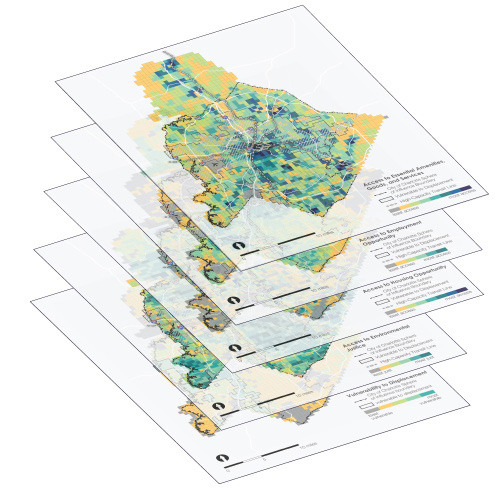
The Comprehensive Plan’s Equitable Growth Framework (EGF) is a key organizing element for the CAPs, ensuring that local policy and investment decisions consider the needs of our most vulnerable populations to address inequities and support Charlotte as a place where all residents can thrive.

The EGF relies on four metrics, and a vulnerability to displacement overlay, to spatially assess varying conditions inform unique needs across different geographies of the city:

  • Access to Essential Amenities, Goods, and Services
  • Access to Employment Opportunities
  • Access to Housing Opportunities
  • Environmental Justice
A layered map presentation showing various geographic data with colors indicating different variables, displayed on transparent sheets. Each layer features a legend to explain the color coding.

Comprehensive Plan Goals

The Comprehensive Plan’s 10 Goals are the foundation for growth strategy in Charlotte. While all the goals are important across all geographies of the city, some rise to the top as most important, considering unique contextual factors and needs (e.g. EGF metrics). To advance the implementation of the Comprehensive Plan goals, the CAPs identify which goals are top priorities based on local needs for each geography.

Comprehensive Plan Place Types & Policy Map

The Comprehensive Plan’s Place Types comprise place-based policies, providing essential direction for 10 unique types and intensities of future development and land uses, building form and design, mobility, and open space integration. The Policy Map represents a spatial translation of these Place Types to specific geographies, providing essential direction to support the City’s growth strategy.

Other Key Plans and Regulatory Tools

Strategic Mobility Plan (SMP)

The Charlotte Department of Transportation (CDOT) developed and oversees implementation of the SMP (adopted in 2022), which outlines a vision to provide safe and equitable mobility choices for people of all ages and abilities. Through this plan, Charlotte will continue our commitment to Vision Zero, establish a 50-50 mode share aspiration, expand transit throughout our city, and prepare for the future of mobility.

The SMP includes the Charlotte Streets Map, which spatially illustrates the multi-modal vision for various arterial street design typologies across the city and provides guidance for public and private investments.

Charlotte Area Transit System (CATS) is embarking on an update to the current 2030 Transit System Plan, with the goal to integrate current strategies and multiple aspects of the transit vision, including the Better Bus Plan, the Rapid Transit Corridor System Plan, and the Envision My Ride Plan.

The Charlotte Regional Transportation Planning Organization (CRTPO) is the federally designated Metropolitan Planning Organization (MPO) for the Charlotte Urban Area, which includes Iredell, Mecklenburg, and Union counties. The CRTPO leads transportation planning efforts for the region, along with the North Carolina Department of Transportation (NCDOT) and the Federal Highway Administration (FHWA), and supports 24 member jurisdictions through coordinated initiatives and the allocation of federal transportation funds. The MTP serves as a key planning resource for these regional efforts.

Mecklenburg County Parks & Recreation developed and oversees implementation of the Meck Playbook (adopted in 2021), which includes four guiding principles that shape system-wide goals, strategies, and recommendations to enhance and improve how the agency will serve the residents of Mecklenburg County. The Meck Playbook provides clear direction on actions that should be taken over then next 10 years and methods to measure progress.

The “Sustainable and Resilient Charlotte by 2050 Resolution” was unanimously passed by City Council in 2018, setting ambitious municipal and community-wide greenhouse gas (GHG) emissions reduction goals for Charlotte. Specifically, it strives for city fleets and facilities to be fueled 100% by zero-carbon sources by 2030 and for Charlotte to become a “low carbon city” by 2050 by reducing GHG emissions to less than two tons of CO2 equivalent per person annually. This resolution prescribed the development of the Strategic Energy Action Plan (SEAP), developed and implemented by the Office of Sustainability and Resilience, to provide guidance to the City for how to reach these goals.

Planning for the maintenance and expansion of public facilities and services is essential, particularly as the city grows, to maintain the high quality of life that residents expect. Key public service providers, including departments and agencies that oversee water and sewer, stormwater, police, fire, parks, and schools, provided critical input to the CAP process, ensuring a common understanding of citywide and place-specific growth projections and strategies. A collaborative planning approach enables providers to maintain existing facilities and effectively plan for future needs by aligning system planning with anticipated future demand.

Charlotte’s UDO (adopted in 2022, effective in 2023) simplifies, consolidates, and updates the regulations that guide development in Charlotte into a single document, making development standards easier to understand and navigate. The UDO aligns these standards with the vision of the Comprehensive Plan and other adopted City policies. The UDO Zoning Districts and Comprehensive Plan Place Types work symbiotically to realize the community’s vision for growth and development as there is at least one Zoning District that aligns with each of the 10 Place Types.

Charlotte’s COO program is a coordinated and strategic investment initiative to foster thriving communities for residents and businesses, to build lasting legacies, and to grow communities equitably. The program, which is cross-collaborative among public agencies and institutions and private philanthropy, targets six historically underinvested corridors to effectively address concentrated areas with specific needs. Each corridor has a unique strategy (COO Playbooks), developed in collaboration with the community to ensure holistic and community-driven equitable investment, designed to guide implementation for projects, programs, and partnerships that advance six of the 10 Comprehensive Plan goals.