This Community Area Plan (CAP) is one tool to support implementation of the citywide Charlotte Future 2040 Comprehensive Plan and the Charlotte Future 2040 Policy Map, providing more detailed guidance for land use, building form, mobility, open space, and public facilities for the West Middle community-level geography. At this scale, the West Middle CAP provides a coordinated, efficient, and effective structure for identifying nuanced and locally-specific needs and priorities. It also provides a structure for developing strategies and recommendations to address those needs and priorities and for contributing to the community’s overarching goal to create a more equitable Charlotte.
This E-Plan serves as a summary of the complete, adopted West Middle Community Area Plan, which can be viewed by following the link below.
On November 24, 2025, Charlotte City Council decided to delay action on this Community Area Plan and the Revised Policy Map for this area to allow for more community input. Additional engagement opportunities are being planned, and more information will be posted on the project website. Plans for these areas will stay on the project website until Council makes a final decision.

West Middle Location Map – Click to enlarge
Community Area Profile
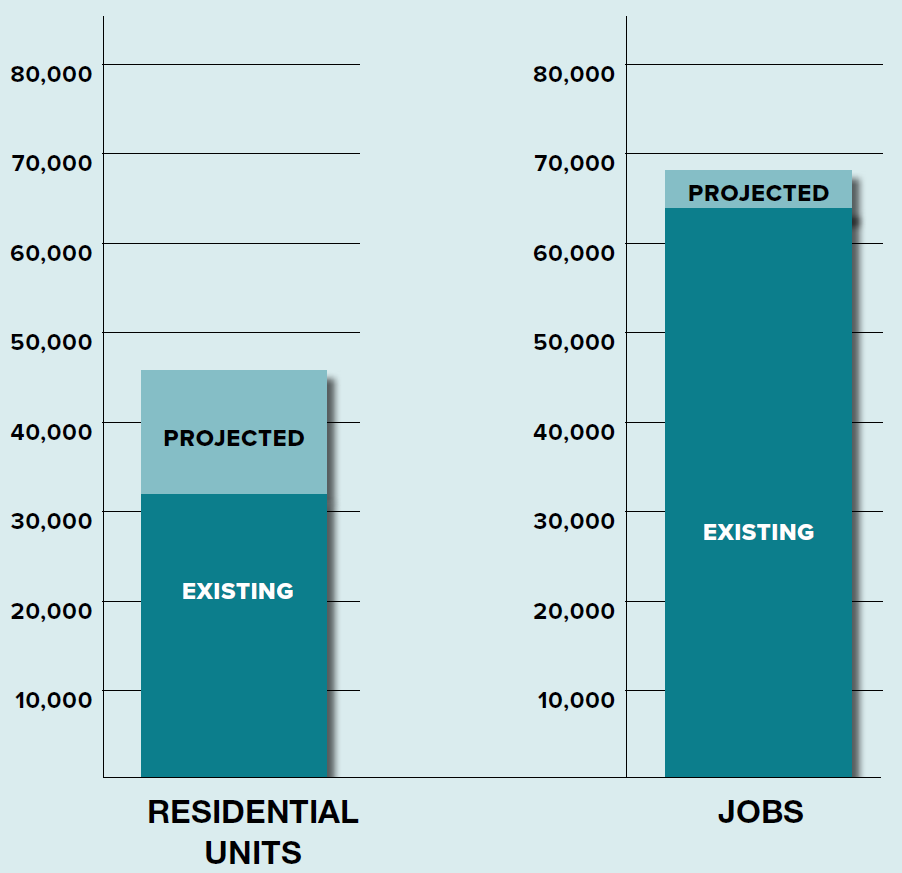
The West Middle geography is roughly bounded by Mt. Holly-Huntersville Road to the north, Statesville Road to the east, Interstate 85 to the south, and Interstate 485 and to the west. The geography includes several regional-serving streets (Freedom Drive, Brookshire Freeway, Interstate 77) radiating outward from Uptown; all of which include high-capacity or express transit service. The area is primarily auto-oriented, single family neighborhoods from the 1940s-1960s. Currently, the area is predominantly characterized by Neighborhood 1, Manufacturing & Logistics, and Parks and Preserves Place Types. The West Middle geography is currently home to 80,559 residents (9% of the city’s population), with more racial and ethnic diversity and lower college education rates than the citywide average. By 2040, this area is expected to grow by 5,437 residential units and 5,437 new jobs (9% and 2% of projected citywide growth, respectively).
Understanding these current conditions and expected growth patterns help in determining the specific needs and priorities for the West Middle area. Specifically, this profile sets the foundation for understanding how local growth and change can contribute to a more equitable city for all by increasing opportunity and access and by reducing harmful impacts. More information about existing conditions can be found in the West Middle Community Report.

West Middle Area Map – Click to enlarge
Expected Growth
The West Middle geography is projected to see an increase of 14,956 residential units, which is 9% of the city’s overall residential growth, and 5,437 new jobs, which is 2% of the city’s total job growth, by the year 2040.
Data Sources: American Community Survey (ACS) 2019, Quality of Life Explorer (QOL) 2020, Community Viz Model 2020, CPA Prioritization Matrix 2019