Community Character

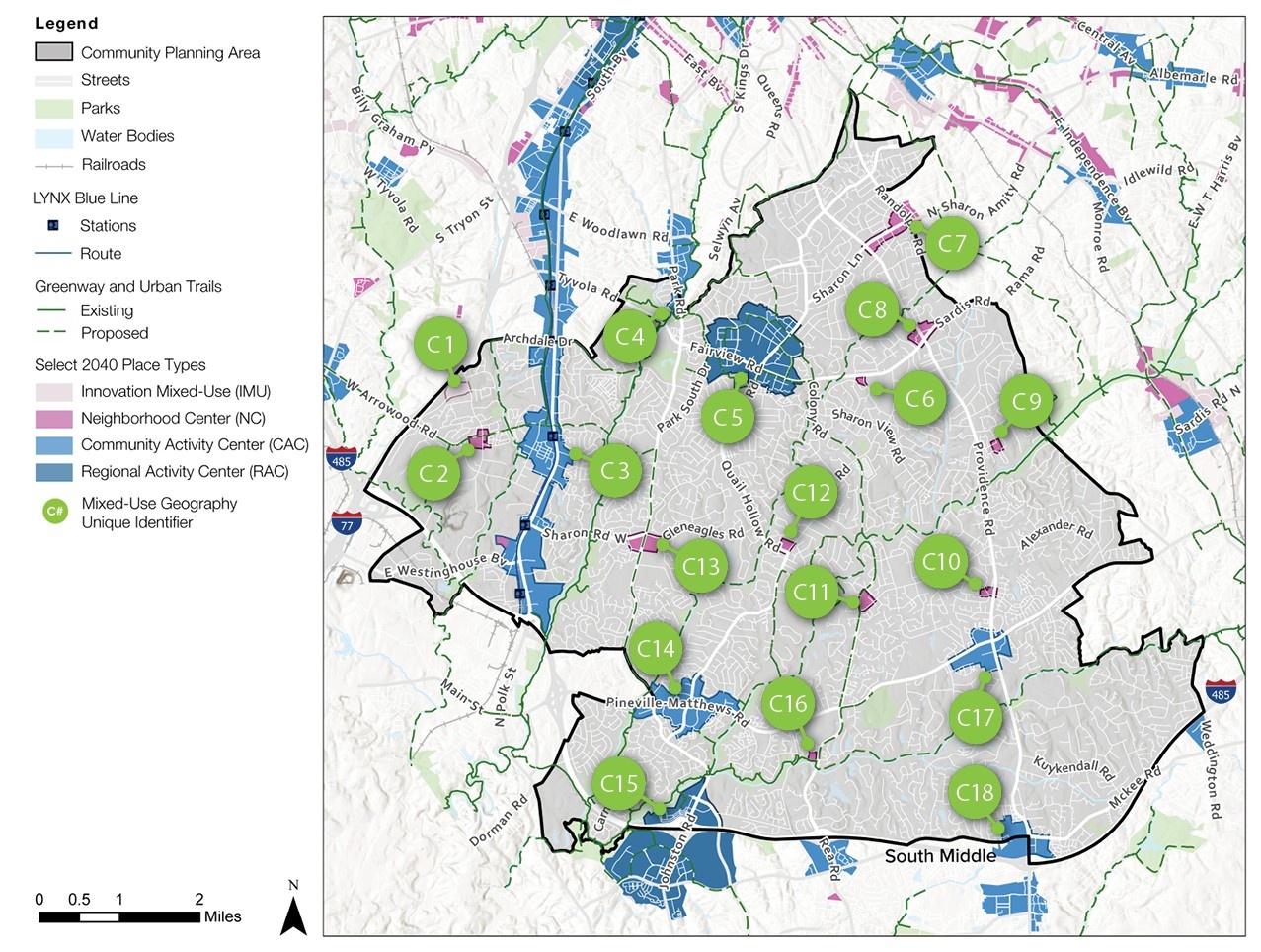
Community Character refers to the distinct qualities and features of a place and may encompass aspects from the physical environment or the people who live in the community. For the Community Area Plans, community character is focused on placemaking, which includes common characteristics and distinctive elements and amenities within the public realm that contribute to vibrant and unique neighborhoods and destinations. As mixed-use Place Types are expected to accommodate the most change and growth, it is important that they provide a high-quality public realm to support higher population and visitation levels, for which specific aspirations are outlined in the Placemaking Aspirations Table. The CAP placemaking assessment for South Middle (illustrated in the Placemaking Assessment Map and Table) documents how well these mixed-use Place Type geographies (Neighborhood Center, Community Activity Center, Regional Activity Center, and Innovation Mixed-Use) align with their placemaking aspirations based on current conditions. This information helps to identify each geography’s greatest placemaking needs and will help guide placemaking-related decisions as development and redevelopment occur in these places, including through private and public investment.

Placemaking Trends

The most common urban typology in the existing South Middle area are strip malls, shopping centers, and large surface parking lots. Most of the existing placemaking elements identified throughout these areas are small public plazas within these shopping spaces, most often set far off of the street. Many include public amenities such as seating areas, creative paving, or public art pieces.

Table 7: Placemaking Aspirational Elements

Placemaking Aspirational Elements
Mixed-Use Place TypePublic SpacesPublic Play AreasAmenities & FurnishingsBrandingPublic ArtSignageProperty Ownership Patterns
Neighborhood Center (NC)Active and passive community gathering spaces are provided, including plazas, patios, courtyards, and parks.Formal and informal amenities that encourage multi-generational play or physical activity are provided, including playgrounds, climbable sculptures, sports facilities, etc.The public realm is highly amenitized, with frequent provision of benches, planters, tables, waste receptacles, lighting, bike racks, and bus stops with shelters.Public and/or private branding contributes to the unique character and identity of the hub. These features help people remember and reference the hub, and often helps to establish hub boundaries.Public art is present to support vibrant spaces and contributes to the unique character and identity of the hub.Wayfinding is provided to support a well-connected, walkable, and easily navigable environment.A diversity of property owners allows for a greater array of business and building types and provides greater opportunity for the creation and operation of a Special District to support local placemaking efforts.
Community Activity Center (CAC)
Regional Activity Center (RAC)
Innovation Mixed-Use (IMU)
A detailed map showing community planning areas, streets, parks, and water bodies. Labeled locations (C1-C18) indicate various place types, including mixed-use geography, community activity centers, and regional activity centers.
Placemaking Assessment Map - Click to enlarge

Table 8: Placemaking Assessment

Placemaking Elements
Mixed-Use GeographyPublic SpacesPublic Play AreaAmenities/FurnishingsBrandingPublic ArtSignageProperty Ownership Pattern
C1) IMU - Forest Point Blvd/Nations Ford RdNot Aligned IconNot Aligned IconNot Aligned IconNot Aligned IconNot Aligned IconNot Aligned IconFew
C2) NC - Arrowood Rd/Nations Ford RdNot Aligned IconNot Aligned IconNot Aligned IconNot Aligned IconNot Aligned IconNot Aligned IconFew
C3) CAC - South BlvdNot Aligned IconNot Aligned IconSomewhat Aligned IconNot Aligned IconNot Aligned IconSomewhat Aligned IconMultiple
C4) CAC - Park RdSomewhat Aligned IconNot Aligned IconNot Aligned IconNot Aligned IconNot Aligned IconSomewhat Aligned IconMultiple
C5) RAC/CAC - Southpark MallAligned IconSomewhat Aligned IconSomewhat Aligned IconNot Aligned IconSomewhat Aligned IconSomewhat Aligned IconMultiple
C6) NC - Fairview Rd/Simsbury RdSomewhat Aligned IconNot Aligned IconNot Aligned IconNot Aligned IconNot Aligned IconNot Aligned IconFew
C7) NC - Randolph Rd/Sharon Amity RdSomewhat Aligned IconNot Aligned IconSomewhat Aligned IconNot Aligned IconNot Aligned IconNot Aligned IconMultiple
C8) NC - Sardis Rd/Providence RdSomewhat Aligned IconNot Aligned IconSomewhat Aligned IconNot Aligned IconNot Aligned IconNot Aligned IconFew
C9) NC - Landmark Dr/International DrSomewhat Aligned IconNot Aligned IconNot Aligned IconNot Aligned IconNot Aligned IconNot Aligned IconFew
C10) NC - Providence Rd/Candlewyck LnNot Aligned IconNot Aligned IconNot Aligned IconNot Aligned IconNot Aligned IconNot Aligned IconFew
C11) NC - Colony Rd/Rea RdSomewhat Aligned IconNot Aligned IconAligned IconNot Aligned IconAligned IconNot Aligned IconFew
C12) NC - Quail Hollow Rd/Carmel RdAligned IconNot Aligned IconNot Aligned IconNot Aligned IconNot Aligned IconNot Aligned IconFew
C13) NC - Gleneagles Rd/Park RdNot Aligned IconNot Aligned IconNot Aligned IconNot Aligned IconNot Aligned IconNot Aligned IconFew
C14) CAC - Pineville-Matthews Rd/Carmel RdNot Aligned IconNot Aligned IconNot Aligned IconNot Aligned IconNot Aligned IconNot Aligned IconMultiple
C15) RAC - Johnstown Rd/I-485Not Aligned IconNot Aligned IconSomewhat Aligned IconNot Aligned IconSomewhat Aligned IconNot Aligned IconMultiple
C16) NC - Red Rd/Bevington RdNot Aligned IconNot Aligned IconNot Aligned IconNot Aligned IconNot Aligned IconNot Aligned IconFew
C17) CAC - Pineville-Matthews Rd/Providence RdSomewhat Aligned IconNot Aligned IconSomewhat Aligned IconNot Aligned IconNot Aligned IconNot Aligned IconMultiple
C18) CAC - McKee Rd/Providence RdNot Aligned IconNot Aligned IconNot Aligned IconNot Aligned IconNot Aligned IconNot Aligned IconFew
Legend
A teal circular icon featuring a dark check mark inside.
Aligned
with Aspirations
Logo featuring a circular design divided into two segments, one teal and the other white, with a light gradient background.
Somewhat Aligned
with Aspirations
A circular logo design featuring a central circular cut-out against a gradient background, primarily in soft colors.
Not Aligned
with Aspirations
Aspirations are outlined in Table 7

* These geographies are within a Corridor of Opportunity.

Community Character Recommendations

CC-1

To reduce the loss of historically and culturally significant structures and spaces and to advance the City’s sustainability and affordability
goals, Charlotte should prioritize the preservation and adaptive reuse of historic or pre-1970s structures. When demolition is necessary, the
City should encourage deconstruction practices to maximize material reuse.

To encourage the preservation and adaptive reuse of historic or pre-1970s structures, Charlotte should survey Community Area Plan
geographies with pre-1970s development to identify key resources and implement appropriate preservation strategies.

To ensure major redevelopment projects adjacent to established neighborhoods are compatible with their surroundings, Charlotte should
develop an Urban Design Standards Manual to guide the integration and transition of new development in a manner that respects the scale,
character, and context of existing communities.

To retain neighborhood culture and identity, Charlotte should use pattern books and regulatory tools such as neighborhood character
overlays, historic districts, and other community-driven strategies to guide residential infill development.

To celebrate neighborhood identity and strengthen the sense of place, Charlotte should support placemaking efforts such as customized
crosswalks, wayfinding signage, public art, and gateway elements at key intersections. Additionally, the city should integrate art and design
into infrastructure and public spaces whenever possible. When feasible, local artists should be commissioned to design the improvements.
Priority should be given to placemaking efforts in mixed-use areas classified as “Not Aligned” or “Somewhat Aligned” in Table 8: Placemaking
Assessment or identified in the Corridors of Opportunity Playbooks. (Cross reference with OS-5)

To create vibrant public spaces that foster community gatherings, Charlotte should explore partnerships with private property owners to
temporarily or permanently transform underutilized areas, such as vacant lots or parking lots, into active public spaces. These spaces should
be programmed with community-driven activities, including community gardens, parks, festivals, and pop-up events.

To create vibrant public spaces that foster community gatherings, Charlotte should repurpose underutilized rights-of-way and city-owned
land into active public spaces. Additionally, the City should establish a long-term strategy for the maintenance, funding, and programming of
all city-owned public spaces and complete the Urban Arboretum Trail. (Cross reference with OS-5)

To enhance public realm amenities in mixed-use places, Charlotte should explore the creation of a fund that supports community-driven
improvements that further the goals of the Charlotte Future 2040 Comprehensive Plan and Community Area Plans.

To support and enhance community character within areas recommended to evolve, Charlotte should survey various aspects of the physical
environment beyond placemaking elements—such as lot size and block structure—within mixed-use areas. The findings should inform land-
use decisions.