Mobility

Mobility is essential in every part of the city and all Place Types, providing a foundation for equitable, safe, and convenient movement between destinations (Charlotte Future 2040 Goal 5). Charlotte has three key mobility partners that play a role in achieving this goal:

  • Charlotte Department of Transportation (CDOT)
  • Charlotte Area Transit System (CATS)
  • Charlotte Regional Transportation Planning Organization (CRPTO)

CDOT is responsible for planning, designing, operating, and maintaining Charlotte’s transportation infrastructure to ensure that it is safe and equitable for all modes of travel, working alongside public and private partners. The Strategic Mobility Plan (SMP) lays out guidance for this important responsibility in alignment with Charlotte Future 2040, including 50-50 Mode Share and Vision Zero aspirations. The Charlotte Future 2040 Street Map is also an important policy guidance tool for implementing the City’s mobility vision, defining three different street classifications with specific multimodal expectations to ensure that our streets continue evolving to meet goals and needs.

Map showing streets and future development areas in a community. It includes a legend indicating different street types, such as Main Street, Future Avenue, and Future Boulevard, with various colored lines representing each category.
South Outer Streets Map - Click to enlarge

To advance and implement the guidance in these policy tools, we must consider and prioritize specific investments and programs that will influence how people move throughout the city in alignment with local and citywide priorities, needs, and land use policies (Place Types), including roadway improvements, pedestrian infrastructure enhancements, bike and micromobility projects, innovation and technology upgrades, support for transit capacity and access, and curbside management interventions. To streamline implementation efficiency for these investments, CDOT is instituting a new mobility strategy by defining across the city, established through a data-driven process to align priorities and needs. Each of the 22 SIAs includes a range of large and small projects that have a place-based focus.

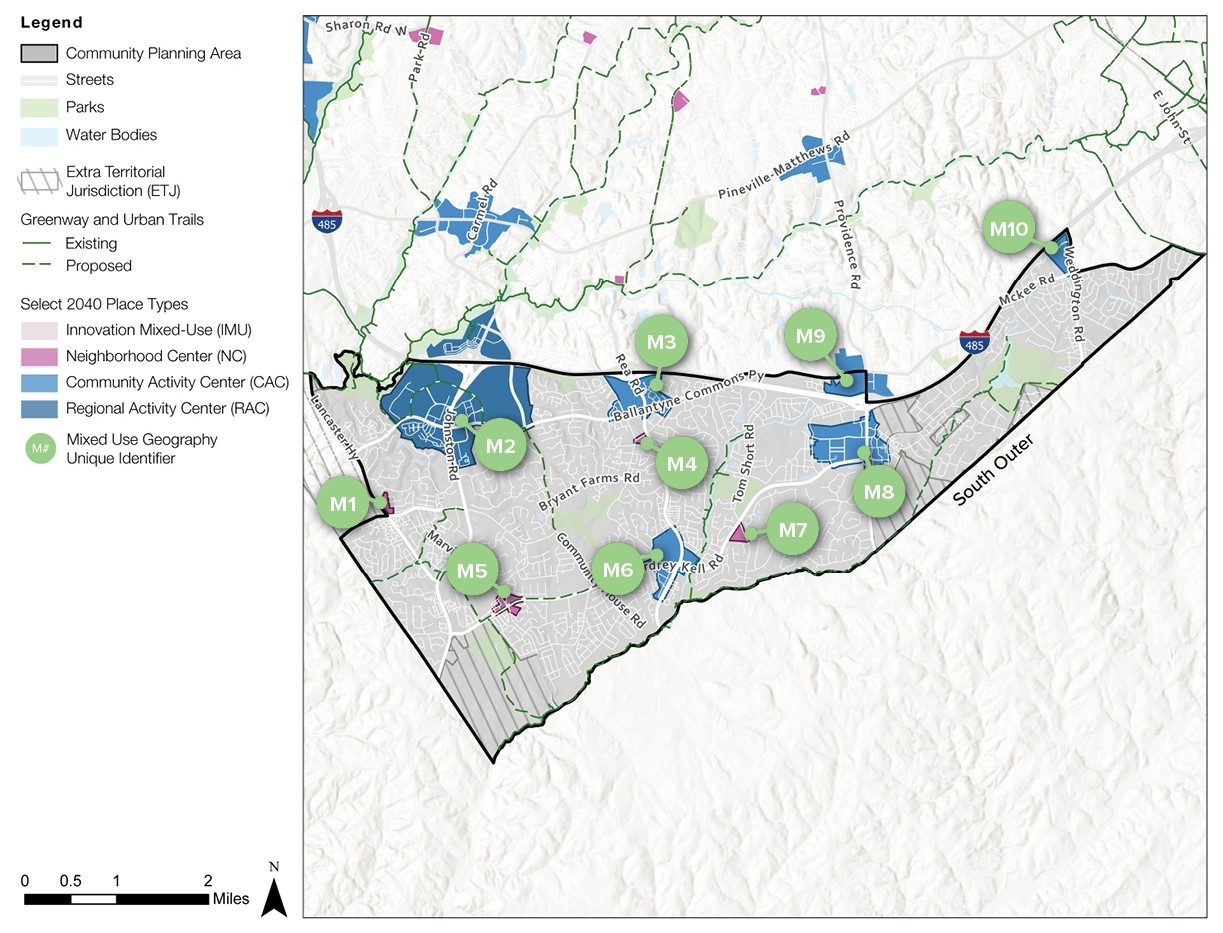
As mixed-use Places are expected to accommodate the most change and growth, it is important that their mobility networks support higher levels of access and activity, for which specific aspirations are outlined in the Mobility Aspirations Table. While most areas identified for mixed-use Place Types align with the designated SIA—which include identified groups of potential projects intended to help achieve mobility aspirations—there are some that fall outside these areas. The CAP mobility assessment for South Outer (illustrated in the Mobility Assessment Map and Table) documents how well these mixed-use Place Type geographies (Neighborhood Center, Community Activity Center, Regional Activity Center, and Innovation Mixed-Use) align with their mobility aspirations based on current conditions. This information helps to identify each geography’s greatest mobility needs and will help guide mobility-related decisions as development and redevelopment occur in these places, including through private and public investment.

Mobility Trends

Some mixed-use geographies in South Outer are within a SIA and have improvements identified. The remaining geographies are generally not aligned with the aspirational characteristics.

Table 2: Mobility Aspirations for Mixed Use Places

Mobility Aspirational Elements
Mixed-Use Place TypePedestrian NetworkBike NetworkCrossingsBlock Lengths & Street NetworkParkingAccess & Internal ConnectionsTransit Access
Neighborhood Center (NC)The pedestrian network is complete, direct, safe, comfortable, and designed to accommodate significant pedestrian activity.

IMU places also need to accommodate truck access in the interim, placing extra emphasis on thoughtful design to reflect these needs while prioritizing the transition to a mixed-use place.
The bike network is complete, well-marked, safe, and easy to use.

IMU places also need to accommodate truck access in the interim, placing extra emphasis on thoughtful design to reflect these needs while prioritizing the transition to a mixed-use place.
There are ample opportunities for pedestrians and cyclists to safely cross busy Arterial streets, allowing for direct and convenient travel between destinations.The street network is well-connected, supports walkability, and provides easy access to centers from surrounding areas and between destinations.Parking may be limited and is typically located and provided in ways that encourage a highly walkable environment.

IMU places also need to accommodate truck access in the interim, placing extra emphasis on thoughtful design to reflect these needs while prioritizing the transition to a mixed-use place.
It is easy to “park once” and walk or use other mobility options between destinations.Centers are easily accessible via transit, and transit facilities are located and designed to support that accessibility.
Community Activity Center (CAC)
Regional Activity Center (RAC)
Innovation Mixed-Use (IMU)
A detailed map showing community planning areas, streets, parks, and water bodies. It includes designations for different place types, such as Innovation Mixed-Use and Neighborhood Center, with a legend and geographic identifiers.
Mobility Assessment Map - Click to enlarge

Table 3: Mobility Assessment

Mobility Characteristics
Mixed-Use GeographyPedestrian NetworkBike NetworkCrossingsBlock Length & Street NetworkParkingAccess & Internal ConnectionsTransit Access
M1) NC - Old Lancaster Town CenterNot Aligned IconNot Aligned IconNot Aligned IconNot Aligned IconNot Aligned IconAligned IconNot Aligned Icon
M2) RAC** - Ballantyne Commons PkwyNot Aligned IconNot Aligned IconNot Aligned IconNot Aligned IconNot Aligned IconAligned IconSomewhat Aligned Icon
M3) CAC** - Ballantyne Commons Pkwy/Rea RdNot Aligned IconNot Aligned IconNot Aligned IconNot Aligned IconNot Aligned IconSomewhat Aligned IconSomewhat Aligned Icon
M4) NC - Rea Rd/Williams Pond LnNot Aligned IconNot Aligned IconNot Aligned IconNot Aligned IconNot Aligned IconAligned IconNot Aligned Icon
M5) NC** - Ardrey Kell Rd/Marvin RdNot Aligned IconNot Aligned IconNot Aligned IconNot Aligned IconSomewhat Aligned IconAligned IconNot Aligned Icon
M6) CAC** - Ardrey Kell Rd/Rea RdNot Aligned IconNot Aligned IconNot Aligned IconNot Aligned IconNot Aligned IconAligned IconNot Aligned Icon
M7) NC - Ardrey Kell Rd/Tom Short RdNot Aligned IconNot Aligned IconNot Aligned IconNot Aligned IconNot Aligned IconNot Aligned IconNot Aligned Icon
M8) CAC** - Ardrey Kell Rd/Providence RdNot Aligned IconNot Aligned IconNot Aligned IconSomewhat Aligned IconSomewhat Aligned IconAligned IconSomewhat Aligned Icon
M9) CAC** - Providence Rd/I-485Not Aligned IconNot Aligned IconNot Aligned IconNot Aligned IconNot Aligned IconSomewhat Aligned IconSomewhat Aligned Icon
M10) CAC - Weddington Rd/I-485Not Aligned IconNot Aligned IconSomewhat Aligned IconNot Aligned IconNot Aligned IconNot Aligned IconNot Aligned Icon

*These geographies are within a Corridor of Opportunity

** These geographies are within a Strategic Investment Area

Legend
A teal circular icon featuring a dark check mark inside.
Aligned
with Aspirations
Logo featuring a circular design divided into two segments, one teal and the other white, with a light gradient background.
Somewhat Aligned
with Aspirations
A circular logo design featuring a central circular cut-out against a gradient background, primarily in soft colors.
Not Aligned
with Aspirations
Aspirations are outlined in Table 2

Mobility Recommendations

Building from and aligning with existing adopted plans, below are the Strategic Mobility Plan recommendations that are most relevant to the needs of this CAP area.

SMP-1

Connected 3.22: Access to Transit – Identify and prioritize new sidewalks, pedestrian crossings, and other pedestrian improvements near transit stations and high frequency priority bus corridors.

Connected 1.12: Connectivity and Access – Require and incentivize connectivity in new development and redevelopment through cross access, connecting and restoring existing streets, block length and connectivity standards, and alternative pedestrian and bicycle connections.

Safe 1.13: Intersection Design – Design intersections to prioritize pedestrians and bicyclists by minimizing crossings distances, maximizing visibility between vulnerable users and motorists, and incorporating geometric design and traffic signal technology that slows vehicular traffic and manages conflict points between vulnerable users and motorists.

New roads constructed in the Extraterritorial Jurisdiction (ETJ) that serve more than one development should be designed and constructed to North Carolina Department of Transportation (NCDOT) standards so that they may be accepted by NCDOT for maintenance following construction.