Open Space
Open Space is an integral component of Place Types and is essential for advancing several of the Charlotte Future 2040 goals. Open Space can include public spaces like parks, recreation facilities, greenways, and preservation areas, and can also include private or semi-private spaces within neighborhoods. Through intergovernmental agreement between Mecklenburg County and the City of Charlotte, Mecklenburg County Park and Recreation (MCPR) has historically managed the acquisition, improvement, maintenance, and operations of parks and greenways in the city. While MCPR will continue to expand and invest in public open spaces with guidance from the , collaboration with the City, private developers, and property owners will be necessary to achieve the community’s future vision and goals and to meet geographic needs as growth occurs.
As mixed-use Place Types are expected to accommodate the most change and growth, it is important that they provide high quality open spaces to support higher population and visitation levels, for which specific aspirations are outlined in the Open Space Aspirations Table. The CAP open space assessment for Southwest Outer (illustrated in the Open Space Assessment Map and Table) documents how well these mixed-use Place Type geographies (Neighborhood Center, Community Activity Center, Regional Activity Center, and Innovation Mixed-Use) align with their open space aspirations based on current conditions. This information helps to identify each geography’s greatest open space needs and will help guide open space-related decisions as development and redevelopment occur in these places, including through private and public investment.
Open Space Trends
Most mixed-use geographies in Southwest Outer have good access to open space and relatively good diversity of parks and greenways. Public plazas and courtyards are generally lacking across most geographies. This is partly because the County has historically been responsible for creating and maintaining open spaces in Charlotte. To support the City’s growing population, Charlotte now aims to expand open spaces with the help of developers and property owners as new development and redevelopment take place. Tree canopy coverage is also good for most geographies.
Table 4: Open Space Aspirations
| Open Space Aspirational Elements | ||||
|---|---|---|---|---|
| Mixed-Use Place Type | Access | Diversity | Tree Canopy In Mixed-Use Places, trees are primarily provided by street trees, along pedestrian paths, and onsite. |
|
| Parks & Greenways | Public Plazas & Courtyards | |||
| Neighborhood Center (NC) | Public open space should be accessible within a 10-minute walk (roughly half a mile) from any point within a mixed-use place. Public open space may include parks, greenways, recreation facilities, plazas and courtyards, or preservation areas. | Mixed-Use places should include a moderate diversity of passive and active open spaces. Passive and active open spaces may include small parks, natural open spaces, greenways, recreation facilities, plazas, patios, and courtyards that may include landscaping. These places should also have a highly amenitized public realm, which is defined as the public space between buildings and the street. A high quality amenitized public realm may include wide sidewalks, seating, plantings, shade, and lighting. Community & Regional Activity Centers should also include open spaces that are developed with trails, amenities, facilities, art, or other investments that add to the space’s natural benefits. | Tree canopy coverage is 25% - 35% | |
| Community Activity Center (CAC) | Tree canopy coverage is 20% - 30% | |||
| Regional Activity Center (RAC) | Tree canopy coverage is 15% - 20% | |||
| Innovation Mixed-Use (IMU) | Tree canopy coverage is 35% - 40% | |||
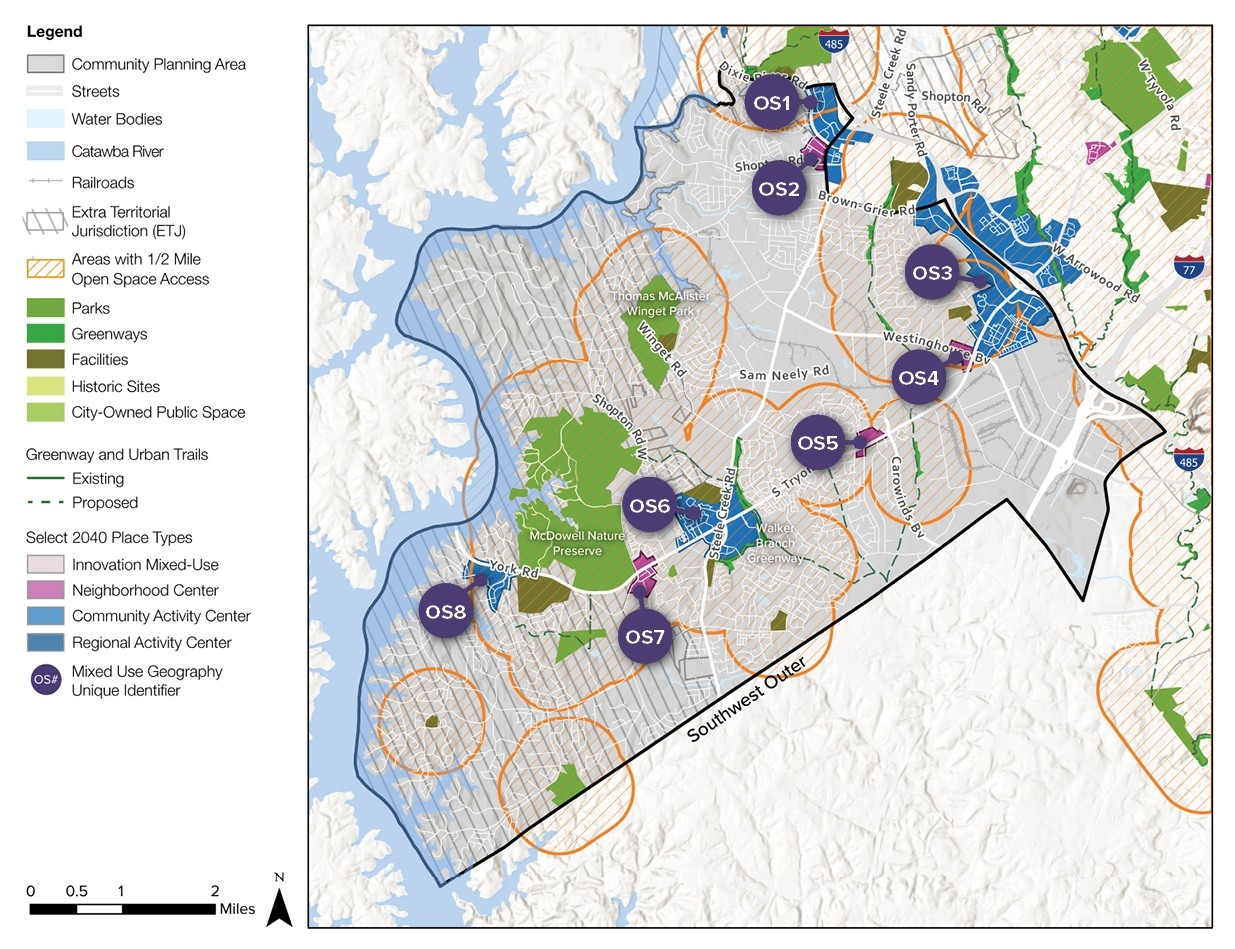
Table 5: Open Space Assessment
| Open Space Current/Planned Elements | ||||
|---|---|---|---|---|
| Mixed-Use Geography | Access | Diversity | Tree Canopy | |
| Parks & Greenways | Public Plazas & Courtyards* | |||
| OS1) CAC - Charlotte Premium Outlets |  | | | |
| OS2) NC - Berewick Town Center |  | | | |
| OS3) CAC - I-485/Whitehall Park Dr/S Tryon St | | | |  |
| OS4) NC - Westinghouse Blvd/S Tryon St | | | | |
| OS5) NC - Moss Rd/S Tryon St | | | | |
| OS6) CAC - Steele Creek Rd/S Tryon St | | | | |
| OS7) NC - Shopton Rd/S Tryon St | | | | |
| OS8) CAC - York Rd/Grand Palisades Pkwy | | | | |
*This assessment reflects the “public spaces” and “public play areas” identified in the Community Character assessment.


Open Space Recommendations
OS-1
To increase access to open space, ensure new development/redevelopment provides enhanced open space(s), as encouraged by the designated Place Type and required by the Unified Development Ordinance. New development/redevelopment in mixed-use Place Types should contribute to the creation, expansion, and/or maintenance of privately-owned public spaces.
OS-2
To help connect and expand Charlotte’s greenway network, new development/redevelopment should, where appropriate, designate property within the FEMA 100-year floodplain and/or the 100-foot Water Quality or Post-Construction buffers (whichever is larger) as open space or greenway, if identified in the Mecklenburg County Greenway Master Plan.
OS-3
To increase access to open space, new development/redevelopment adjacent to existing or planned Mecklenburg County parks or greenways should provide connections to the open space, if deemed feasible by Mecklenburg County Park and Recreation.
OS-4
To ensure future development supports Charlotte’s aspiration of accessible and diverse open spaces, the City should track, digitize, and calculate walking distances to public open spaces provided through private development, such as plazas and courtyards.
OS-5
To increase access to open space, Charlotte should repurpose underutilized rights-of-way and city-owned land into active public spaces. Additionally, the City should establish a long-term strategy for the maintenance, funding, and programming of all city-owned public spaces. Priority should be given to potential projects that fall within areas classified as “Not Aligned” or “Somewhat Aligned” in the CAP Open Space Assessment Tables or identified in the Corridors of Opportunity Playbooks. (Cross reference with CC-6 & CC-8).
OS-6
To maximize the use of and access to existing open space, the City of Charlotte and/or Mecklenburg County should formalize joint-use agreements for playgrounds, fields, and tracks on Charlotte-Mecklenburg School sites, both existing and future.
OS-7
To maintain and expand Charlotte’s tree canopy within mixed-use areas, the City should continue purchasing and preserving parcels through the Tree Canopy Preservation Program.
OS-8
To maintain and expand Charlotte’s tree canopy, the City should expand options for the Affordable Housing Bonus Program to allow contributions to a Tree Canopy Preservation Fund in lie of on-site requirements.